
Department of Energy Awards FSU Physicist Hitesh Changlani a Grant to Study Out-of-Equilibrium Quantum Matter
The U.S. Department of Energy (DOE) has awarded a grant to Florida State University physicist Hitesh Changlani and his collaborator at Brown University. The 3½-year research award started in July 2026. It provides about $2 million in total to FSU and Brown, of which $760,000 supports Changlani’s work at FSU on the project titled “Uncovering Dynamical Phases of Out-of-Equilibrium Quantum Matter with Neutron Scattering.”
Changlani is a theorist specializing in condensed matter theory and computation. His collaborator, Brown University Professor Kemp Plumb, is a neutron scattering experimentalist with whom Changlani has previously studied highly frustrated magnets. Such magnets have many competing ground states, which can make them easier to manipulate or give rise to exotic phases such as “quantum spin liquids,” whose unconventional excitations can be detected indirectly by neutron scattering. The experiment-theory team will utilize resources at Oak Ridge National Laboratory (ORNL), which has an active partnership with FSU as part of the Neutron-Nexus program.
“Hitesh became a leader in the Physics Department very early in his career here”, said Dr. Paul Cottle, chair of the FSU Department of Physics. “This collaboration with Brown University demonstrates that he is continuing to develop in this leadership role. In physics, building collaborations requires both confidence and scientific maturity, and Hitesh is demonstrating that he is growing in both of those dimensions.”
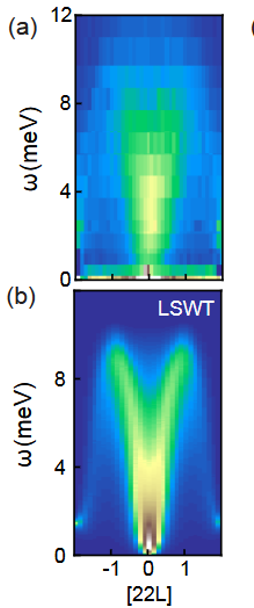
Changlani and Plumb previously carried out studies on highly frustrated spin-1 pyrochlore systems. These systems display some remarkable properties in equilibrium, such as a continuum of excited states—often a hallmark of “fractionalization,” a quantum many-body effect that is common in one dimension but much rarer in three dimensions. More recently, the team realized that such systems may also harbor interesting out-of-equilibrium properties, with anomalous relaxations when subjected to a magnetic field quench. Inspired by recent advances in the field of non-equilibrium physics, and building on their collective expertise, the team developed these ideas into the DOE proposal over many months. Changlani’s expertise in modeling neutron scattering data is key, because it provides insight into how collective phenomena of electron spins occur in quantum materials, especially those which have many competing states. With the DOE grant, the team will develop a neutron scattering approach for quantum materials driven out of thermal equilibrium, something that is not yet well established.
Understanding these processes will help build a framework for how quantum many-body systems reach equilibrium. “Our proposal for performing time-dependent neutron scattering complements other out-of-equilibrium techniques and should shed considerable light on magnetic properties of slowly relaxing systems,” Changlani said.
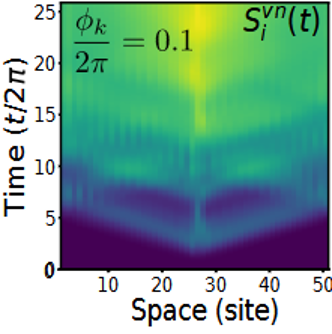
For Plumb, this means being able to probe the real-time dynamics of quantum magnets and how they “relax” in different conditions. Typically, this relaxation is too fast to capture. However, Plumb and Changlani have identified magnetic materials where the relaxation is slower, which makes them well suited to the new measurements. “It is like watching a movie of the electronic correlations in the quantum material in real time,” Changlani explains.
The project could lead to new discoveries about how quantum matter behaves. For Changlani, one of the most inspiring aspects of the grant is the chance to contribute to the “non-equilibrium frontier” of quantum materials science. “I am excited to have received this grant as it will help me pursue new directions in this rapidly evolving field,” he said.
The grant will support graduate students and postdoctoral researchers in Changlani’s group, along with regular visits to Brown University and presentations at conferences. The project builds on Changlani and Plumb’s past collaborations, using spin dynamics simulations to develop a detailed real-space picture of how magnets respond to magnetic field manipulations.
Dr. Michael Shatruk, director of the FSU Quantum Initiative, said, “The award received by Prof. Changlani is a clear testament to the excellence of his research ideas. We are fortunate to have him as part of the FSU Quantum Initiative, where he contributes both through impactful research and through the training in quantum science provided to students and postdocs.”
The research has implications for both quantum science and condensed matter physics. “Many aspects of research in the area of out-of-equilibrium quantum dynamics intersect with the emerging area of quantum information science; in fact, the lines dividing it from condensed matter physics have truly blurred,” Changlani said.
Quantum science has had lasting impacts on daily life, from the invention of the transistor, which underpins modern electronics, to quantum chemistry, which is used in drug design. The emergence of vibrant new research areas, such as quantum information science, quantum sensing, and metrology, indicates that a lot more is in store. “Being an active member of FSU’s Quantum Initiative has given me the opportunity to have a close view of developments in this area,” Changlani said. The FSU Quantum is very excited about this project and the potential impact it could have on quantum science and future quantum technologies.