
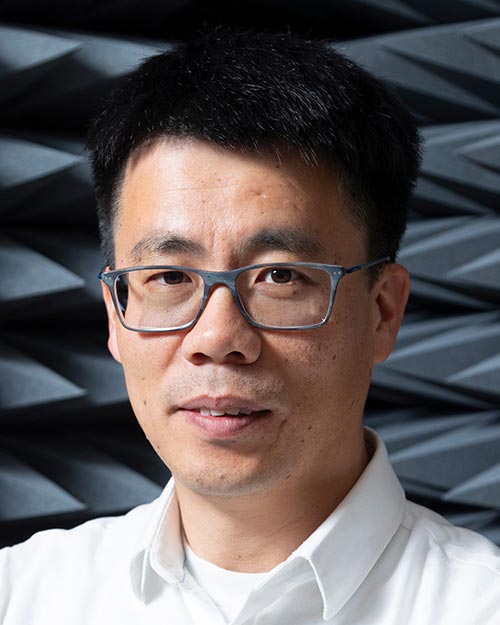
Dr. Bayaner Arigong, Associate Professor
Education and Training:
- 2005: BS in Electrical Engineering, China University of Geoscience
- 2008: MS in Electrical Engineering, China University of Geoscience
- 2015: PhD in Electrical Engineering, University of North Texas
Tell us a little about your background – where did you receive your undergraduate / graduate degrees?
After I received my undergraduate and master’s degree in Electrical Engineering, I worked in the industry for 3 years and then came to the United States for my PhD degree in the area of electromagnetic and high frequency chips, circuits, and system design.
When did you join FSU? What made you choose this university to build your research program?
After 3 years as a chip design engineer in Silicon Valley, I decided to come back to academia to explore creative research work that I am interested in, as well as to shape the next generation of engineering in terms of skills and knowledge required in an industry environment. Thus, in 2020 I joined the Electrical & Computer Engineering departments at FAMU-FSU College of Engineering.
When did you become interested in quantum research? Who or what inspired you?
Since 2022, I started looking into quantum computer and quantum engineering research and found that there are a lot of overlaps and foundational ties close to the electromagnetic field and microwave frequency circuits and systems. These connections me to bring the advanced technology in the microwave domain into quantum research for developing new quantum integrated chips.
What are your current research interests? Could you give an example of some recent result that you feel especially passionate about?
My current research interests include microelectronic emulated quantum system platforms, integrated quantum chips, and quantum and microelectronics hybrid computing and communications systems. I’m excited that we secured $5M research funding from the National Science Foundation to build research and education facilities in quantum chip and emulated platform development.
How would you describe your research to the general public? Why is your topic important?
Operating a quantum computer is costly and not energy efficient, which are the main challenges for commercialization of quantum computers for practical applications. My research in microelectronic emulated quantum systems will provide low-cost end-user platforms to accelerate quantum computing in our current data-congested applications.
What do you think about the future of quantum research? How can FSU contribute to that future?
The future will be full of quantum, and the applications will span the areas of materials, drugs, food, life science, healthcare, and national security. FSU is positioned in a great place to bring expertise from different areas to contribute to the future of quantum research and technologies.
What inspires you? Or what obstacles have you overcome on your journey in quantum research?
Quantum requires multidisciplinary knowledge from physics, engineering, information science, and computer science, which makes it challenging to build actual hardware systems. At the same time, those challenges are interesting, as they cause me to think out of the box to build something new that has never been explored in any other field.
What are your interests outside of research? What do you like to do in your free time?
Outside of research, I like to travel and spend time with my family.