
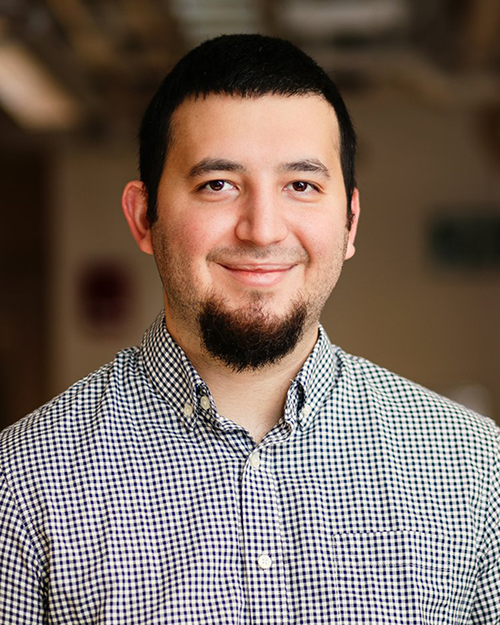
Bryan Kudisch, Assistant Professor
Department of Chemistry & Biochemistry
Education and Training:
- 2015: BA in Chemical Physics, Columbia University
- 2020: PhD in Chemistry, Princeton University
- 2020-2023: Postdoctoral Researcher, Harvard University
Tell us a little about your background – where did you receive your undergraduate / graduate degrees.
I received my bachelor’s degree from Columbia University in Chemical Physics and did undergraduate research with Xiaoyang Zhu studying the surface photophysics of lead halide perovskite materials. From there, I moved to Princeton University and, while working under Gregory Scholes, I developed and implemented ultrafast spectroscopic methods to elucidate the fundamental photophysics of light harvesting and electron transfer in model molecular systems. During my postdoctoral research tenure, I investigated the photochemical mechanisms of newly discovered photocatalysts used for synthetic organic chemistry.
When did you join FSU? What made you choose your university to build your research program?
I joined FSU in 2023. There were many attractive aspects of building my research program here: First and foremost, FSU has an incredible history and current strength in photophysics and photochemistry. Secondly, the instrumentation and experimental accessibility is top tier — in the morning, I could use a one facility to perform ultrafast spectroscopic measurements on my samples of interest, and that afternoon I could perform the same experiment at 25 T at the proximal National High Magnetic Field Facility. Few institutions provide access to the first experiment, and none beside FSU allow this combination! Lastly, I was excited to join an esteemed list of colleagues both peripheral to my field and outside of it that were independently successful and willing to support me as their junior colleague.
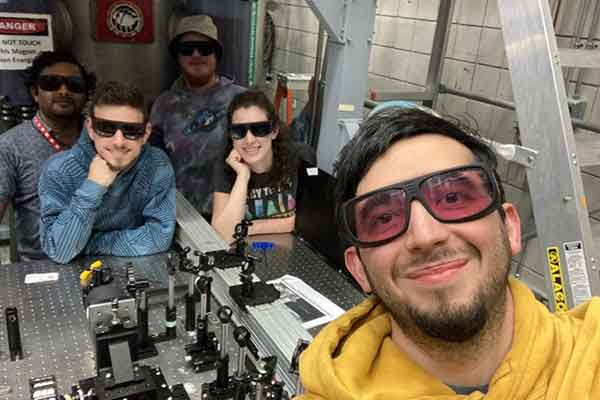
The Spring 2025 Kudisch Lab performing high magnetic field ultrafast spectroscopy measurements.
When did you become interested in quantum research? Who or what inspired you?
While the term “quantum research” has recently begun to mean something very specific related to up-and-coming quantum technologies, quantum mechanics underlies all of chemistry, especially the interactions between light and molecules. In this sense, my interest in modern “quantum research” came from realizing how concepts in quantum sensing can help us answer some of the hardest questions in chemistry. Quantum sensors boast such high sensitivity or accuracy because they map some environmental/external phenomena onto a quantum mechanical observable property of your sensor. This has inspired parts of our current program on mapping chemical properties onto quantum mechanical observables during photochemical reactions. I think that this is a really interesting and underexplored junction that is primed to help us experimentally observe chemistry in nanoscopic detail.
What are your current research interests? Could you give an example of some recent result that you feel especially passionate about?
My research interests are fairly broad, but center on photochemical reactions that occur fractions of a second after light is absorbed. It turns out “fractions of a second” is putting in a lot of “work” in that sentence, since we’re really thinking about reactions happening on the timescale of a millionth of a billionth of a second. I’m really interested in how to get direct evidence about the way chemistry happens when it does happen this quickly, and it turns out that there are powerful and incisive spectroscopies that are really only useful on this timescale but have mostly been utilized on model systems—like what I did during my PhD. The chemical systems that we focus on now, though, are real photocatalysts and photoreagents employed by synthetic chemists around the world to make molecules, and so, by understanding how these light absorbers function productively on a fundamental level, we hope to achieve a broader impact in guiding the design of more efficient chemical reactions. We recently demonstrated the success of our approach in a recent publication.
How would you describe your research to the general public? Why is your topic important?
Synthetic chemists are getting better and better at using light to make molecules—kind of like plants using light to generate their “food”, we have learned how to use light to generate fine chemicals ranging from medicine to pesticides. But just because the chemical reactions work doesn’t mean that we know how they work or that they can’t work better or more efficiently. To this end, we use laser spectroscopy to help us uncover the “how” and the “why” behind new photochemical reactions that helps stimulate innovation in the development of new reactions and helps us understand the scope of what is possible when light and molecules interact.
What do you think about the future of quantum research? How can FSU contribute to that future?
I think that the future of quantum research is bright, but not necessarily in the ways many are currently envisioning. Science has a way of humbling scientists that think they know what the future holds. In this vein, I think FSU can contribute to this future by leveraging the broad range of different types of quantum expertise among the faculty, and fostering a research atmosphere that encourages creative intersection of our research programs.
What inspires you? Or what obstacles have you overcome on your journey in quantum research?
My inspirations are my students and questions about how the world works. It’s such a privilege to be able to design experiments and formulate hypotheses that increase our collective knowledge and deepen our connection to the world; this is one of my daily motivations. I, like everyone else, want answers to the big questions, but to me the most tantalizing questions are the ones that are just out of reach, but that my expertise can contribute to answering. I’m similarly privileged to be able to train students not just in doing challenging and rigorous science but also in channeling their own curiosity and motivation to accomplish their unique goals. Being able to pursue answers to burning questions with my colleagues and trainee’s makes research even more enjoyable.