
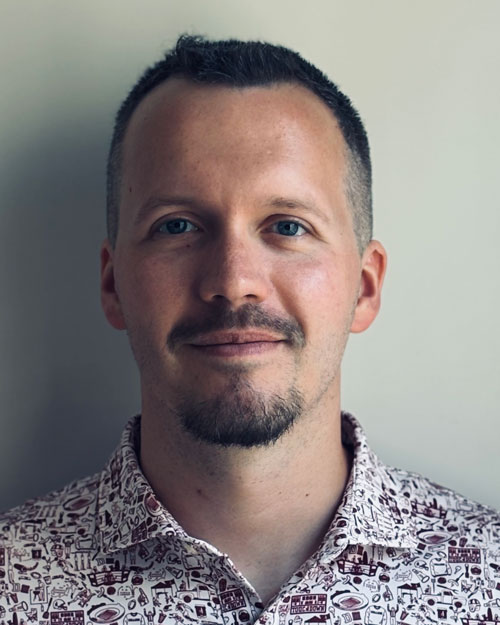
Eric Kubischta, Assistant Professor
Department of Mathematics
Education and Training:
- 2016: BS in Mathematics and Electrical Engineering, North Dakota State University
- 2018: MS in Electrical Engineering, North Dakota State University
- 2025: PhD in Applied Mathematics, University of Maryland College Park
When did you join FSU? What made you choose your university to build your research program?
I joined FSU in 2025 as an assistant professor in the Department of Mathematics. I was excited about FSU because it gives me the opportunity to build a research program in a strong math department while also being part of a broader quantum community. My work is mostly mathematical, but it is closely connected to questions coming from physics, chemistry, and quantum information science. Being at FSU lets me develop the mathematical side of my research while also engaging with researchers in other disciplines who are thinking about quantum systems from different perspectives.
When did you become interested in quantum research? Who or what inspired you?
My interest in quantum information grew while I was doing my master’s degree in classical information theory. Quantum information theory felt like a natural next direction, especially since I had always enjoyed both mathematics and popular science books about physics. That combination led me to pursue a PhD in applied mathematics at the University of Maryland, which has a strong quantum research community. During that time, I became especially interested in quantum error correction, where ideas from information theory, mathematics, and quantum physics all come together.
What are your current research interests? Could you give an example of some recent result that you feel especially passionate about?
My research is in quantum error correction, with a particular focus on how symmetry influences the structure and properties of quantum codes. Recently, we developed a notion of an “intrinsic” quantum code, which exists abstractly and is independent of any particular physical realization. This perspective allows properties of the intrinsic code to descend to its physical realizations, giving a unified way to study families of concrete codes. I also study weight enumerators and MacWilliams transforms for quantum codes. These tools provide fundamental constraints on code parameters and overall code performance. We have recently developed these tools in the setting of intrinsic quantum codes.
How would you describe your research to the general public? Why is your topic important?
Quantum computers are very sensitive to noise, so quantum error correction is needed to protect quantum information from errors. My research studies the mathematics behind these codes, especially how symmetry controls their structure. One theme in my work is separating the abstract code from a specific physical realization of that code. This helps us understand which properties come from the underlying symmetry of the code itself and how those properties affect its ability to deal with noise.
What inspires you? What obstacles have you overcome on your journey in quantum research?
I am especially inspired by one of the most successful paradigms of 20th-century physics: understanding physics through symmetry. Symmetry is not just a convenient way to simplify a problem; it can reveal the underlying structure of a physical system. In my work, I try to bring this perspective to quantum error correction. The goal is to understand quantum codes through their symmetries, and to see how those symmetries dictate their error-correcting properties and physical realizations.
What do you think about the future of quantum research? How can FSU contribute to that future?
It is hard to predict the future of quantum research as a whole, but quantum error correction seems likely to remain a central challenge. As quantum devices improve, we will need a better understanding of what kinds of quantum codes are possible and what structure they can have. FSU is well positioned to contribute because the FSU Quantum Initiative brings together researchers from mathematics, physics, chemistry, computer science, and engineering. That kind of interdisciplinary environment is especially important for quantum research, where progress often depends on connecting ideas across fields.
What are your interests outside of research? What do you like to do in your free time?
Outside of research, I enjoy spending time with my wife, my daughter, and my two Russian blue cats. I also enjoy working in my garden, where I am trying to grow more fruit trees than my yard can reasonably justify. I also enjoy weightlifting, golfing, cooking, and grilling.