
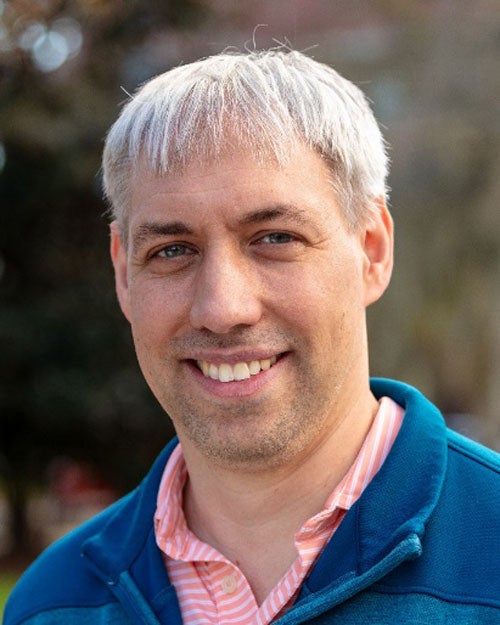
Kenneth Hanson, Cottrell Family Professor
Education and Training:
- 2005: BS in Chemistry, St. Cloud State University
- 2010: PhD in Chemistry, University of Southern California
- 2010-2013: Postdoc, University of North Carolina-Chapel Hill
After changing majors four times and spending two summers doing research at Notre Dame and UCLA, I graduated with my B.S. in Chemistry from St. Cloud State University in 2005. During my undergraduate research experience, I learned about organic electronics and the research of Dr. Mark Thompson at the University of Southern California, who later became my graduate mentor. My love of molecular photochemistry/photophysics dramatically grew during my graduate work which primarily focused on synthesizing light-absorbing and light-emitting molecules for use in OLEDs and OPVs resulting in me obtaining my Ph.D. in 2010. My journey in photochemistry then continued as a postdoc at UNC-Chapel Hill where I performed spectroscopic measurements on molecules and materials for applications in solar energy conversion.
When did you join FSU? What made you choose this university to build your research program?
I began my independent career at FSU in 2013. Given the legacy and continued strength in molecular photochemistry and photophysics at Florida State University, the choice to become a professor in the Department of Chemistry & Biochemistry was an easy one. That strength, combined with the outstanding user facilities, proximity to the Mag lab, collaborative environment, and forward-thinking initiatives, pushed FSU above and beyond anything I could have hoped for in a faculty position.
When did you become interested in quantum research? Who or what inspired you?
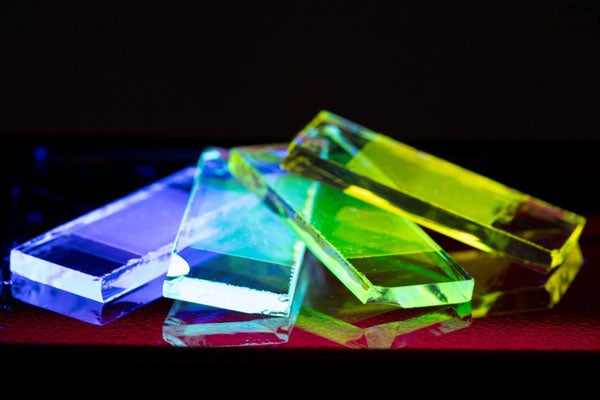
Ever since I was a graduate student I have been interested in how applied magnetic and electric fields impacted the interaction between light and molecules. But with the recent wave of interest in quantum information sciences, I became aware of the alignment between my interest and what is now described as “quantum research”. As a photochemist, photons (i.e., packets of light) are my hammer and I see every problem as a nail, including those in the domain of quantum sciences and engineering.
What are your current research interests? Could you give an example of some recent result that you feel especially passionate about?
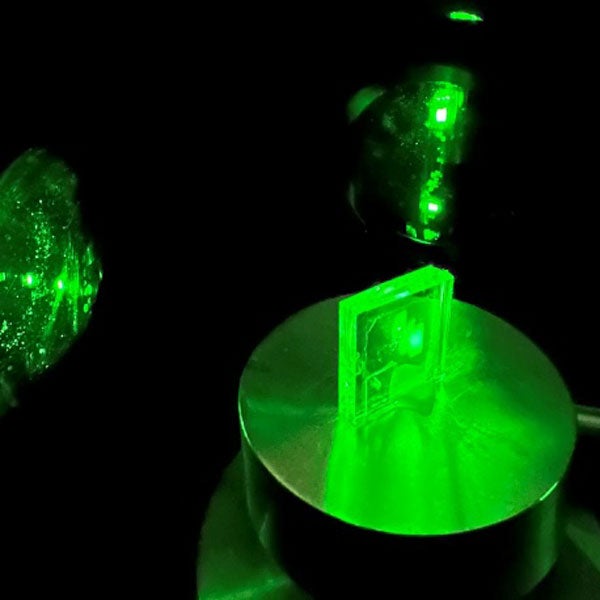
The primary interest in the Hanson research group is to understand and control the excited state properties of molecules on solid surfaces. While the properties of molecules in solution are interesting for many applications, if you want to harness those properties in a solar cell or electrochemical sensor, for example, they have to interact with a surface. Likewise, while much progress has been made in using crystalline materials in quantum sciences and engineering, one can envision a future where molecules on surfaces play a critical role in generating read-write interfaces or sensing devices.
What do you think about the future of quantum research? How can FSU contribute to that future?
While the foundation of what is now known as quantum science and engineering was laid decades ago, we still don’t have the insights or tools necessary to control and harness these phenomena on an atomic/molecular level. Likewise, while our understanding of quantum events continues to grow, the community will inevitably discover new processes, materials, and applications. The FSU Quantum initiative, combined with the research and tools already active at FSU, makes us uniquely positioned to contribute to this foundational understanding and open the door to harnessing quantum information in current and yet to be dreamed of applications.
What obstacles have you overcome on your journey in quantum research?
One of the things I have struggled with most with this domain of research is just how counterintuitive behaviors in the quantum realm can be. We govern most of our day-to-day life decisions based on classical mechanics (a.k.a. Newtonian physics). But when things get really fast or small, all those rules are abandoned and electrons can travel through walls, light goes partially through even a perfectly reflecting surface, and atoms can be in multiple states at the same time, for example. It really challenges you to reevaluate how you think about the world around us.
What are your interests outside of research? What do you like to do in your free time?
Aside from biking and spending time with my family, one of my major areas of interest outside of research/teaching is video games. Beyond playing them, I have combined my interest with science in my Ask a Scientist Gaming livestream Q&A on Twitch.tv. Every other Wednesday night I invite a colleague to join me on stream, including members of FSU Quantum, to play their favorite video games and answer questions from the live chat. It is not only fun to hang out and chat with my colleagues but also an opportunity to learn about cutting edge science outside of my primary domain of expertise.