
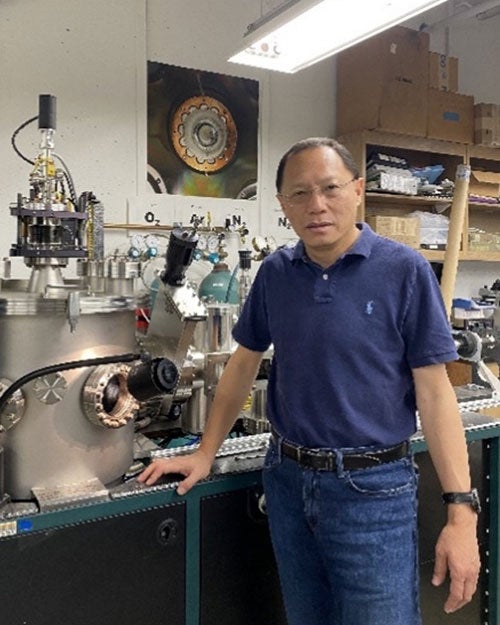
Dr. Peng Xiong, Distinguished Research Professor
Education and Training:
- 1987: BS in Physics, University of Science and Technology of China
- 1993: PhD in Physics, Brown University
- 1993-1997: Postdoctoral Scholar, University of California, San Diego
Tell us a little about your background – where did you receive your undergraduate / graduate degrees?
I did my undergraduate study in China in the 1980s, back when the best high school graduates were almost expected to study math and science. Although occasionally I wonder what it could have been if I had chosen a different field of study, I've had no regrets going into physics. In 1987, I entered Brown University for graduate study. After spending two years on classes and deliberating between theoretical and experimental research, I joined a new group to do my Ph.D. dissertation. I was the first graduate student in a brand-new lab, where I had the chance to set up state-of-the-art research facilities in a couple of essentially empty rooms and work on several disparate research projects. Those were very challenging few years, but the experiences were extremely valuable when I was building my own laboratories at FSU. I then spent four years as a postdoc at UCSD, where I had the resources and intellectual freedom to explore. That was when I really matured as a physicist.
When did you join FSU? What made you choose your university to build your research program?
I joined FSU in November 1997. I chose FSU because I believed it was the best place to pursue the research I was interested in. I was attracted by the Center for Materials Research and Technology and the National High Magnetic Field Laboratory, especially the many legendary scientists associated with them.
When did you become interested in quantum research? Who or what inspired you?
That really depends on the definition of "quantum research". My main research interests have long been novel physics in low-dimensional materials and nanostructures, and quantum mechanics is always important at nano scales. An example I often cite is that the transistor could not have been invented without quantum mechanics, so it can be justifiably called a "quantum device". The current "quantum research" is more about directly harnessing the weird quantum properties such as superposition and entanglement for computing, sensing and communication. My current research covers both types of "quantum research".
What are your current research interests? Could you give an example of some recent result that you feel especially passionate about?
Generally speaking, my current research is still about new physics and phenomena that emerge when one confines electrons in low-dimensions and deliberately designed nanostructures. In the past decade or so, I became increasingly interested in new emergent phenomena when various symmetries in the crystalline and electronic structures of materials are broken. We've dedicated a lot of effort to the so-called CISS effect, which has to do with how electron spins become spontaneously polarized when they travel through materials exhibiting structural chirality, or broken mirror symmetry. The effect raises many fundamental physics questions and carries important practical implications in spintronics and quantum information science.
How would you describe your research to the general public? Why is your topic important?
I am always reluctant to describe how 'useful' my research might be, whereas I am always excited to tell how interesting it is. I am a big believer that intellectual curiosity is the ultimate driver for discoveries that lead to practical use. When pioneers such as Paul Dirac studied quantum mechanics a century ago, they were not thinking about computers and cell phones, but their discoveries were responsible for the semiconductor microelectronics we have today.
What do you think about the future of quantum research? How can FSU contribute to that future?
I am cautiously optimistic. No one can be certain that quantum research will deliver on all the fantastic applications it promises. There is no doubt in my mind, however, that these research efforts will lead to many exciting scientific and even technological breakthroughs. I believe we in FSU should certainly be at the forefront of quantum material and quantum device research. But perhaps more importantly, we should take the opportunity to further strengthen our physical and intellectual infrastructure for quantum research. Once we have the technical and intellectual foundations, we will be in position to play leading roles in whatever becomes the "hottest" areas of research in the future.
What inspires you? Or what obstacles have you overcome on your journey in quantum research?
The ultimate inspiration in research for me is to discover something new. Experimental physics research involves a lot of mundane and often frustrating work. But it's all worth it when you realize that you have found something no one else has ever known before; not many things in life could beat that feeling.
What are your interests outside of research? What do you like to do in your free time?
I am an avid sports fan. I used to play quite a bit of soccer; now I just watch games on TV when I can. More recently, I've become interested in pickleball, and I play as much as my knees would allow me to.